Home › Home battery
Home battery
Home battery installation in Flanders and Brussels
Dyness LFP battery with a Solis or Deye hybrid inverter, fully installed and inspected. 10 kWh from €4,200 (single-phase, 6% VAT).
Fixed prices
Prices by type of grid connection
Exact price after a free check of your meter box.
5 kW hybrid inverter
Single-phase · 230 V
Homes with a single-phase connection
Warranty: inverter 10 years · battery 10 years / 8,000 cycles
- 10 kWhfrom €4,200
- 16 kWhfrom €4,700
- 32 kWhfrom €6,950
10 kW hybrid inverter
Three-phase · 400 V + N
Three-phase grid with neutral
Warranty: inverter 5 years (Solis) or 10 years (Deye) · battery 10 years / 8,000 cycles
- 16 kWhfrom €5,700
- 32 kWhfrom €7,800
- 48 kWhfrom €10,450
- 64 kWhfrom €12,570
10 kW hybrid inverter
Three-phase · 3×230 V
Three-phase without neutral. Requires a suitable inverter.
Warranty: inverter 5 to 10 years depending on the brand · battery 10 years / 8,000 cycles
- 16 kWhfrom €6,100
- 32 kWhfrom €8,100
- 48 kWhfrom €10,750
- 64 kWhfrom €12,870
Not sure which grid you have? Send a photo of your meter box via WhatsApp, and we will tell you.
Including hybrid inverter, Dyness battery, installation, materials, up to 5 m of cable from the distribution board and AREI inspection. 6% VAT. Larger systems for businesses and farms: price on request.
System calculator
Which system suits me?
Inverter, battery and panels in one go: answer a few short questions and instantly see an indicative price.
Prefer another brand, such as Huawei, SMA, Victron or Pylontech? Then we make you a tailor-made quote.
Indicative, incl. the selected VAT. The exact price follows after a check of your meter box and may change after a site visit.
For an exact calculation: download your quarter-hour data (15 minutes) from Mijn Fluvius and send it to us via WhatsApp or email. That shows exactly how much you export during the day, what you draw in the evening and which inverter power you need. Not required: a first estimate is also possible with your annual consumption.
Not sure about the capacity? First read which home battery do I need (NL).
Why a home battery?
- Use daytime solar power in the evening
- Lower monthly peak, so a lower capacity tariff
- Smart charging and discharging with a dynamic energy contract
- Option: backup socket during a power cut
- Also works with existing solar panels
We work out the capacity from your consumption. For a family with 5.8 kWp of panels, 32 kWh only brought €60 a year more than 16 kWh. So we simply recommend 16 kWh. Read also: a battery with existing solar panels (NL).
How it works
How your energy system works
Your panels work for you first. With a dynamic tariff, the battery also charges when electricity is cheap.
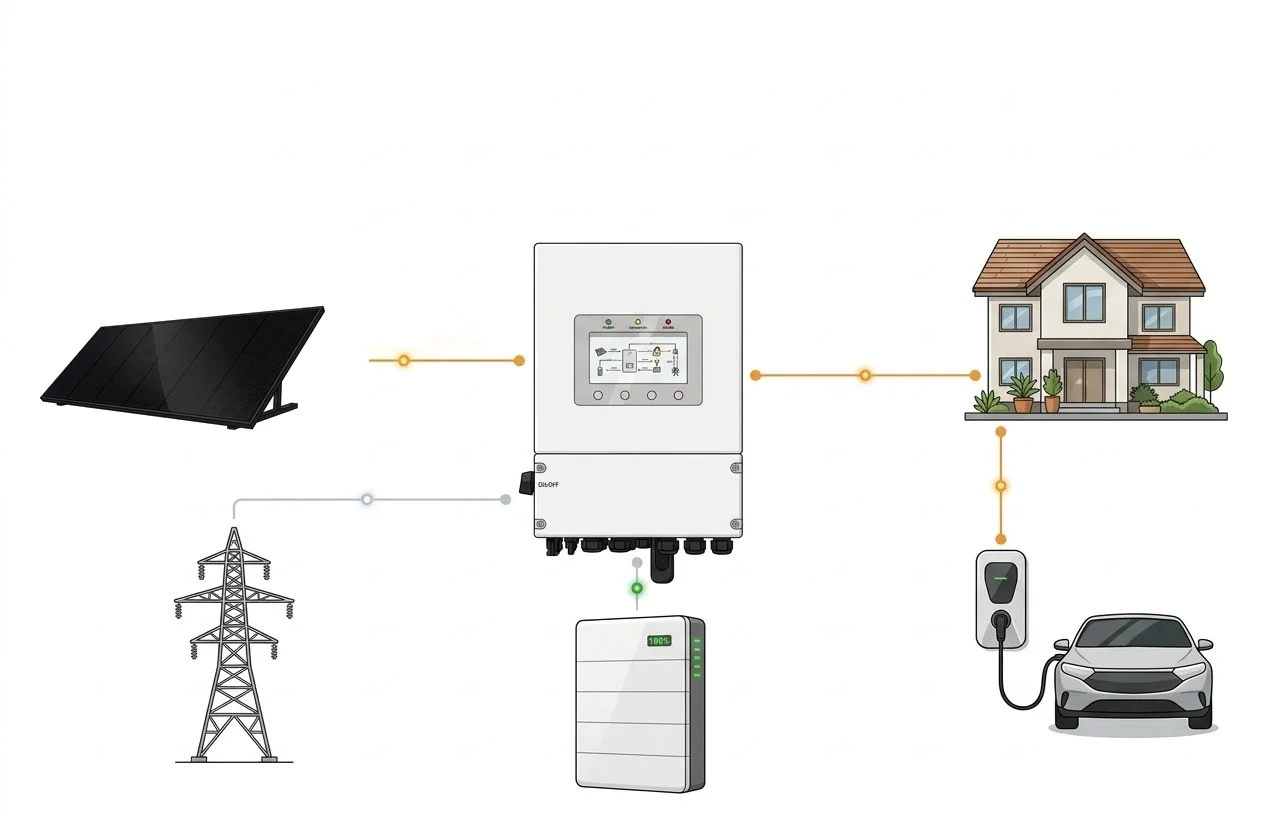
The sun rises. Power from your panels goes to your home first, and through the home to your car charger. You use your own electricity and buy less from the grid.
Whatever you don’t use at that moment charges the home battery. Without a battery, that power would go to the grid for a low feed-in compensation.
Only when the battery is full does the surplus go to the grid as feed-in. The inverter handles this by itself, you don’t have to do anything.
The sun sets and the lights go on in the house. In the evening and at night your home takes its power from the home battery instead of the grid. Tomorrow the sun charges the battery again.
A winter day with little sun. The inverter with AI EMS knows the hourly prices and the weather forecast. During the expensive morning hours the battery powers your home.
Around midday the price drops. The battery and your car then charge from the grid, together with the little solar power. The battery only charges if the price gap with the evening is large enough.
In the evening electricity is most expensive. The home then takes its power from the battery, so you buy almost nothing from the grid during those hours.
Forecasts sun and consumption
With a dynamic tariff the inverter uses its own free AI control: it looks at the weather forecast, your consumption and the hourly prices, and decides by itself when the battery charges or discharges.
In winter, charge at the lowest tariff
With a dynamic contract the battery tops up at the cheapest hours and supplies at the most expensive ones. Only if the price spread covers the charging and discharging losses.
Lower monthly peak
The capacity tariff is based on your highest quarter-hour of the month. The battery absorbs those peaks, even when the charger and oven run together.
Everything in one app
You see live what the panels produce, what the house uses and how full the battery is. We set everything up and keep an eye on it after installation.
Also control the heat pump and EV charger?
Want the inverter, heat pump and EV charger controlled together? That takes a separate energy management system (EMS). It is installed separately and has a monthly subscription; we look together at whether it is worth it for you.
Does charging from the grid always pay off?
Not always. Charging and discharging loses about 10%, and at night you still pay grid costs and levies. So we honestly work out for your contract whether it is worth it. In summer the battery almost always simply charges from your own solar power.
What is included, and what may cost extra
Included in the price
- Hybrid inverter (Solis or Deye)
- Dyness LFP battery, expandable later
- Installed by us, no subcontractors
- Materials, protection and up to 5 m of cable from the distribution board
- Energy meter, programming and app
- AREI inspection of the new installation
- Help with registration via Mijn Fluvius
- 6% VAT (home over 10 years old)
What sometimes costs extra
- Cable longer than 5 m, wall drilling or cable trunking
- Earthing found not compliant at inspection: extra earth rod or repair
- Full or outdated distribution board: extra enclosure or protection
- Defects in the existing installation found by the inspector
- No suitable wall: extra bracket or fire-resistant board
- Existing inverter that cannot work with the battery
- Option: backup socket during a power cut (EPS)
- Solar panels: aerial lift for difficult access, removal of old panels, slate or asbestos roof
- EV charger: cable longer than 10 m or digging to the driveway
- New build or home under 10 years old: 21% VAT
If the inspection still reveals something, we discuss it with you first, before doing anything.
How we work
- 1
Send a photo
Of your meter box and inverter, via WhatsApp or the form.
- 2
Fixed price
With your grid type, the distance to the distribution board and photos, you get a clear quote within 24 hours, with no obligation.
- 3
Installation
Neatly installed, no subcontractors, usually in 1 day.
- 4
Inspection & Fluvius
We arrange the AREI inspection and help with registration at Fluvius.
FAQ
What does an installed home battery cost?
On a single-phase connection: 10 kWh from €4,200, 16 kWh from €4,700 and 32 kWh from €6,950, including hybrid inverter, installation, materials, up to 5 m of cable and AREI inspection, with 6% VAT. On three-phase 400 V + N: 16 kWh from €5,700, 32 kWh from €7,800, 48 kWh from €10,450 and 64 kWh from €12,570. On 3×230 V: 16 kWh from €6,100, 32 kWh from €8,100, 48 kWh from €10,750 and 64 kWh from €12,870.
How quickly do I get a quote?
Within 24 hours, if we have your grid type, the distance to the distribution board and a few photos. After a site visit the price may still change; we always say so before installation.
How long does installation take?
We usually install a home battery in one day.
How do you determine the right capacity and inverter power?
We make a first estimate from your annual consumption. If you have a digital meter, we prefer to calculate with your quarter-hour data from Mijn Fluvius (in Brussels: Sibelga). It shows your export, your evening consumption and your peaks, and so which battery and which inverter power really suit you.
Which grid type do I have: single-phase, 3×230 V or 400 V + N?
You can tell from the main switch and wiring in your meter box. Don’t open it yourself: just send us a photo via WhatsApp and we will tell you.
Can a battery be added to my existing solar panels?
Yes. Either we replace your inverter with a hybrid inverter, or we place a battery next to the existing installation. If you still receive green certificates, we usually leave the existing inverter untouched.
Your quote within 24 hours
Fill in the form or send us a photo of your meter box right away. Free and without obligation.
Within 24 hours if we have your grid type, the distance to the distribution board and photos. After a site visit the price may still change; we always tell you before installation.